For latest news follow
'Ring of Parks' tweets &
campaigning web sites
below
Tweets by @ringofparks
Liverpool Campaign web sites
Save
Sefton Park Meadows on Facebook
Saveseftonparkmeadows.org
Walton Hall Park Community
Save
Woolton Woods on Facebook
Save
Harthill and Calderstones on Facebook
Save Allerton Priory on Facebook
Save Our Green Spaces Liverpool on facebook
email
saveourgreenspaces liverpool
Liverpool City Council
All
committee meetings
weekly
& current planning applications
planning
explorer
Strategic green & open spaces review board
National
The Parks Alliance
National Federation of Parks
of Green Spaces
UK ‘Save Our Parks’ petition
Open
Space Society
The Land Trust
Fields in Trust
Groundwork
DEFRA
English Heritage
Historic England
European Landscape Convention
European
Landscape Convention
icomos-uk PDF
Anna Minton author Ground Control
State of UK Public Parks report from the Heritage Lottery Fund

Garden Festival Site
A public consultation for housing plans on the Garden
Festival site is scheduled to be held at Sefton Park Library from 30 November
to 3 December 2016 during library hours 11am-6pm. The consultation display
will then be moved to the Town Hall.
The City Council bought back the lease for the Garden Festival site last
year with the Mayor promising to create a new cultural destination. The
full planning application for the Festival site was approved after the
public enquiry in 2008/9.
The original approved plans were for two phases of development with Phase
I to build 936 two-bed and 372 one-bed apartments. But will Phase II,
for controversial plans to build 7 luxury apartment blocks over Otterspool
Promenade, be revealed at this public consultation?
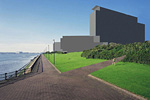
7 'finger blocks' for Otterspool Promenade?
Safety & Ecological concerns swept aside for 3G football hubs
Serious safety questions over the crumb-rubber used in
3G artificial pitches were swept aside as Liverpool follows Sheffield
by approving four football hubs sponsored by the Football Association.
Two separate Synthetic Turf and Health Reports were prepared for the Council
in March this year but these were only made available to Liverpool’s
Planning Committee when the fourth football hub was approved for the Heron
Eccles Playing Fields on the 1st November.
But Council Officers advised the Planning Committee that ‘health
concerns were not an issue for consideration under the planning process’.
Surely, public concerns regarding the adverse health effects of tyre crumb
should be taken into account as a relevant factor in a planning decision?
A statement from the Football Association was presented to the committee
giving assurances that 3G pitches were safe. However, it's the Government's
agency, DEFRA, who are the lead body responsible for Environmental Health
and chemical pollution. DEFRA have said they will soon release a position
statement to be agreed with the FA and Sport England. It's assumed the
Council will wait for DEFRA's response before any further 3G pitch developments
take place.
The City Council is the effective owner of the land earmarked for these
football hubs. Separate to planning permissions, as landowner, the Council
can refuse to release land for development and not allow a change of use
for these green spaces – especially if approved development plans
are potentially dangerous.
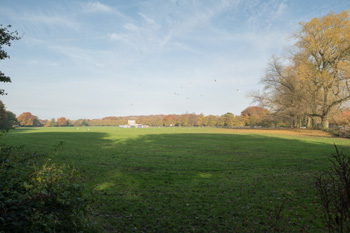
The Simpson Ground between the Eric Hardy Nature Reserve and Woolton Woods
- part of the Calderstones-Woolton Green Wedge.
Another concern is the erosion of the City’s ‘protected’
Green Wedge. The Simpsons Ground and Jericho Playing Fields, both approved
for 3G football hubs, fall within the City’s Green Wedge. Liverpool’s
current planning rules are meant to safeguard Green Wedges from the harmful
impacts on biodiversity and wildlife within protected areas. By approving
these urbanising developments the City Council appears to be ignoring
National Planning Policy Framework guidelines as well as it’s own
rules and stated policies.
Each hub includes 3 full sized 3G artificial grass football pitches built
with associated changing rooms, floodlighting, perimeter fencing and hard
standing for car parking. If these football hubs are completed they will
be privately managed and operated commercially.
Liverpool will contribute £4.4m to this scheme as announced in the
Mayoral
Recommendation for 3G pitches.
Details of these planning applications can be found on the Council's Planning
Explorer links here:
Simpsons Ground, off Hillfoot Road.
Jericho Lane Playing Fields, near Otterspool Park.
Heron
Eccles Playing Field.
Read
the Liverpool Echo feature on Heron Eccles 3G pitches.
Read
Carley Graham's article on the dangers of 3G rubber-crumb pitches.
Calderstones Harthill Park development plans
The Save Harthill and Calderstones Park group are currently
campaigning for people to object to Redrow's planning application to build
on the Harthill Estate which is part of Calderstones Park. The land is
opposite Calderstones School on Harthill Road and includes the former
greenhouses/council depot, former Beechley Nursing Home, Beechley Riding
Stables, Calder Kids Liverpool and the land used by the model railway
group.
Redrow Homes is proposing to erect 39 dwellings with associated parking
and access roads following demolition of existing non listed buildings.
To convert Beechley House, stables and summer house into 12 apartments
with associated parking.
The so-called 'consultation' provided by Redrow is a web site statement
of what their plans will be: www.harthillroad.co.uk
Objections for this planning application can be made by quoting reference
no.16F/2049 by email to: planningandbuildingcontrol@liverpool.gov.uk
Details of this planning application can be found on the Council's Planning
Explorer link here:
Calderstones & Harthill Park - described as Land at Harthill Road.
See Save
Harthill and Calderstones on Facebook
See Liverpool
Confidential feature: Calderstones land earmarked for luxury housing
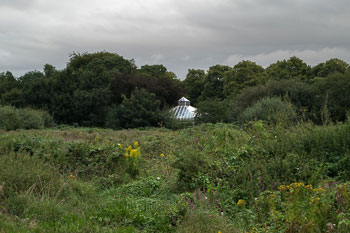
Council depot at Harthill, Calderstones Park.
The glasshouse containing the Bronze Age Calderstones will likely be relocated
to the Reading House in the Calderstones Park if development plans are
approved.
Allerton Priory development plans on Green Wedge
Redrow Homes have made an addition planning application
to knock down parts of the Grade II listed walls for vehicle access to
the Allerton Priory land.
Previously, Redrow Homes submitted an outline planning application to
build up to 160 dwellings on land by the Grade II listed Allerton Priory,
by Woolton Road. This privately owned land is a substantial part of the
Calderstones-Woolton Green Wedge that should be protected according to
the city’s existing UDP policies. These former
agricultural lands have remained relatively untouched for at least 20
years and have become an important wildlife haven.
Liverpool's Green Party state in their online article that 'Allerton
Priory site must be saved for future generations to enjoy as Redrow plans
to build 160 houses on proposed wildlife site'.
Objections for these planning applications can be made
by quoting Planning Application references:16O/1191 for the housing
development and 16L/2392 to remove parts of the wall - by email to: planningandbuildingcontrol@liverpool.gov.uk
Details of the application for 160 dwellings can be found on the Council's
Planning Explorer here:
Allerton Priory - described as Land at Woolton Road Liverpool L18 9UZ.
Details for the wall application here: Planning
Explorer: Allerton Priory Walls- 10 Dec. 2016
See
Save
Allerton Priory on Facebook
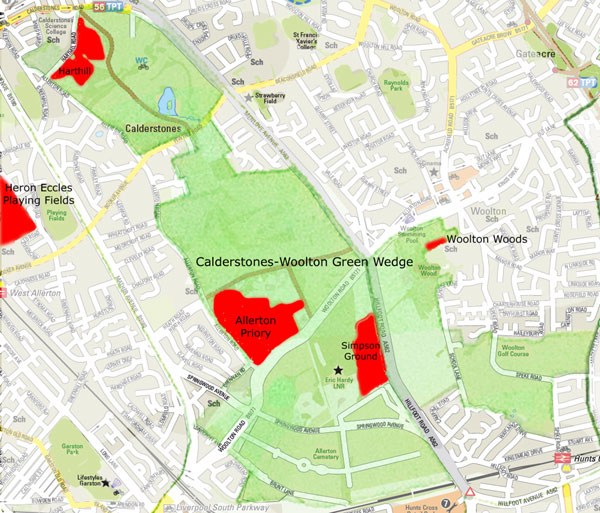
Calderstones-Woolton Green Wedge (UDP)
Areas marked in Red are development sites approved or with submitted planning
applications.
Liverpool's draft Local Plan
The Liverpool Local Plan will map out and set rules for the future growth
of the whole city - shaping the neighbourhoods in which we all live and
work for the next 15 to 20 years. The scope of the Local Plan is wide
ranging and will shape future Council decisions from housing to green
space and from transport to culture.
Liverpool’s existing Unitary Development Plan (UDP) policy will
be replaced by Liverpool’s Local Plan once government inspectors
approve this new planning policy - probably in summer 2017.
The purpose of the Local Plan is to help achieve sustainable development
which means ensuring that better lives for ourselves don’t mean
worse lives for future generations. Sustainable development is about change
for the better, and not only in our built environment.
The formulation of the Local Plan comes at a time when central government
cuts are severely biting into the City Council’s budget. Without
any statuary obligation to fund parks and greenspace the Council predict
that by 2017 there will be no money to maintain these public green spaces.
This period also coincides with the government’s push for local
authorities to provide more houses.
Housing developers are keen to exploit this situation and are persuading
the city to part with historic parkland for housing schemes. Redrow Homes
North West is the Council’s preferred developer and they favour
building on previously undeveloped green spaces. In recent years Redrow
have acquired from the city five former school playing fields and designated
green space for housing schemes. Redrow now have their sights on the highly
profitable areas of green space located in the leafy suburbs of south
Liverpool for ‘executive’ homes – particularly public
parkland such as Sefton Park Meadows and the recreational land of the
Harthill Estate at Calderstones Park.
In line with all local authorities across the country this is part of
the National Planning Policy Framework and is meant to be a collective
enterprise that places importance on community engagement in a meaningful
way.
Liverpool’s Draft Local Plan documents can be found here: http://liverpool.gov.uk/localplanconsultation.
Liverpool’s Green & Open Spaces Report
The Green & Open Spaces Review Board Final Report was
published on 6 October and the pdf report can be downloaded here: http://liverpool.gov.uk/media/1355752/green-spaces-strategy-web.pdf
Liverpool is one of the few local authorities to commission a major strategic
review of green and open spaces for the city. This mayoral commission
was established at the end of 2014, in part, reacting to the high profile
and vocal campaigns of local people to save Sefton Park Meadows, Walton
Hall Park and Woolton Woods. However, during the first consultation for
Liverpool’s Local Plan a number of house builders also recommended
a review of the city’s green space and green wedge land –
to encourage the city to provide a planning policy structure to identify
the best green spaces to exploit for development.
The Green & Open Spaces Review Board’s research was carried
out to inform and feed into the city’s Local Plan.
Government Inquiry - The Future of Public Parks
The Communities and Local Government Committee has launched
an inquiry into the Future of Public Parks and open spaces. The inquiry
will examine the impact of reduced local authority budgets on public open
spaces and consider concerns that their existence is under threat.
This inquiry has a national significance. It has the potential to influence
Government policy makers to set guidelines for all local authorities.
The Commons Select Committee wants to encourage as many people as possible
to contribute to the inquiry and must receive written submissions by 30
September 2016. For more details see Communities
and Local Government Public Parks launch web site.
Following pressure from UK greenspace organisations, such as
the National
Federation of Parks of Green Spaces, The
Parks Alliance and others, the previous outgoing government
administration recommended that the newly elected Government consider
hosting a National Inquiry into the future funding and management of our
parks.
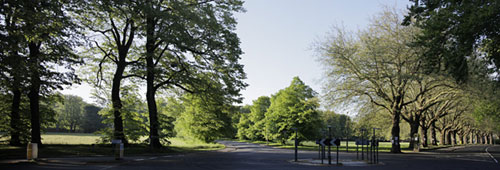
Sefton Park Meadows - the Meadow Fields dissected by Park Avenue at the
entrance to Queens Drive.
Sefton Park Meadows - Freedom of Information
A recent FOI request has revealed correspondence in internal emails
between Liverpool City Council and Redrow from the end of 2014 to 30 March
2016 about the ongoing negotiations over the sale of Sefton Park Meadows
see the Campaign
to Save Sefton Park Meadows web site for more details about the 'Damning
Secret Negotiations Revealed with Redrow Homes'.
The FOI reveals that Redrow offered £4m (including all Council costs)
for the green open space land of Sefton Park Meadows. This figure differs
greatly from the £10m promised by the Mayor of Liverpool 3 years
ago. At the end of March 2016 no independent land valuation had been established.
It appears the Mayor had plucked a figure out of the air when he announced
£10m for the sale of the Meadowlands - largely to impress the media
and public.
In its press release the Campaign to Save Sefton Park Meadows notes discussions
at the highest Council level over the Mayor’s outspoken intervention
into the quasi-judicial planning process along with comments to ‘tone
it down’ to avoid adverse public reaction.
The Campaign to Save Sefton Park Meadows has stated:
‘We demand to know exactly where the proposed sale is up to.
Transparency and accountability should be paramount in all Council matters,
especially in the matter of the proposed sale of Sefton Park Meadows which
has such a high level of public interest’.
The FOI documents can be found here:
https://www.whatdotheyknow.com/request/sefton_park_meadows_2016#incoming-839414
The Campaign
to Save Sefton Park Meadows is in its third year since this
parkland was incorrectly described by a Council disposal notice in March
2013 as ‘incidental’ space off Park Avenue. The campaign is
ready to act if and when Redrow Homes NW presents it’s application
to the planning committee to build executive homes over the entire 6.5
acres of this spectacular public green space.
For over three years there has been a great deal of public misinformation
and misleading assertions from the Mayor regarding the status, disposal
and so-called beneficial sale of the designated green space of Sefton
Park Meadows. The land is officially described in Council bye-law records
as the Meadow Fields of Sefton Park. During the late 19C when villa style
houses were being built around Sefton Park in 1887 Liverpool Corporation's
Council rejected any further plans to build over the Meadowlands of Sefton
Park.
more details on Sefton Park Meadows
from 2015.
Civic Society's recommendations for Parks & Green Space
Merseyside Civic Society (MCS) has recently released it's
five recommendations for Liverpool's Parks and Green Space Review Team
which also criticised Liverpool's Head of Planning.
The pdf detailing the 'Planning context and background to MCS Five Recommendations'
can be downloaded here.
The 2015 report details the following points:
1. Differentiate between historic parkland and grassed-over demolition
sites
2. Measure the number of park users to enable impacts to be better understood
and demonstrated
3. Identify providers with public funding that benefit from parks and
should contribute more
4. Smart management and maintenance
5. Linking up Liverpool’s Parks and Promenades in a Green Web.
In the report MCS said it was disturbed to hear Liverpool’s Head
of Planning publicly make the case that protections on green space, and
prioritising the recycling of brownfield land, ‘do not work’.
MCS stated 'this is wrong, and risks undermining the turnaround in population
only recently achieved, by encouraging those who argue for purely market
led land allocation. Wider green-belt protections, alongside brownfield
first targets, have supported urban renaissance in all of the core cities
and would be folly to discard'.
MCS also states that 'Parkland in Walton Hall, Newsham Park, Sefton Park
Meadow and Calderstones, etc. has been managed and used as such throughout
the last century and beyond. Areas with such long established recreational
use should never have been proposed for development by officers or approved
by politicians in the Local Plan ‘call for sites’.
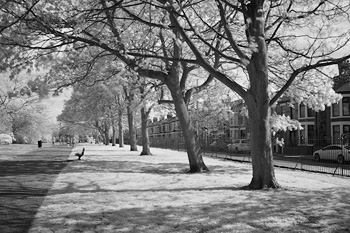
A section of Walton Hall Park's perimeter footpath
Reprieve for Walton Hall Park
Good news for campaigners to save Walton Hall Park - in
a joint statement from Liverpool City Council and Everton Football Club
it was announced that plans to build a new stadium in the park has been
abandoned. It was also reported "that effectively building a new
village in North Liverpool with lots of retail space is a step too far
in this current economic climate."
However, these recent announcements fall short of a clear statement about
the scheme to build a 1000 houses over a section of Walton Hall Park's
130 acre grounds.
News reports to cancel plans for a new stadium on Walton Hall Park were
announced in the Liverpool Echo on 16 May from the following links: 'Campaigners
Celebrate' and 'Mayor
says Everton will have new stadium in 3 years'
The Friends
of Walton Hall Park have been campaigning to save their park
since September 2014 when Everton Football Club confirmed they wanted
to build a new football stadium over the Park. The expectation to acquire
this historic and popular park is made possible by the support of Mayor
Anderson and his powerful rule over the Labour-led Council. This park
is the only public green space in a densely populated area.
The origins of Walton Hall Park date back to 1199. Will English Heritage
and it's recently formed planning arm of Historic
England give it's blessing for the sale of any part of Walton Hall
Park - as it did for Grade II listed Stanley Park when up to half of this
historic park was sold to Liverpool FC?
Liverpool - Overall loss of 30 acres of parkland and green space from 2012 to 2016
Is Joe Anderson being economical with the truth with claims
that he has created 67 acres of green space in Liverpool since he first
became Mayor in 2012? The facts reveal a different story - it is estimated
there has been a total net loss of at least 30 acres of green space in
Liverpool over the last 4 years.
Most of Anderson’s ‘new’ green space is an invention
and is creatively called 'renewed' green space made up of established
and existing designated green space - with some land brought back into
temporary use. This 'new' space is mostly from two sites next to one another
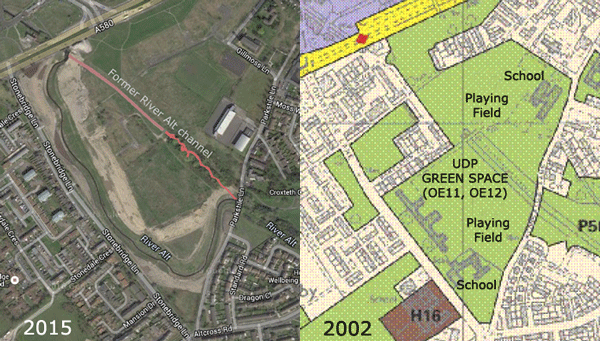
in north Liverpool. Some 21 acres of land around the altered channel of
the River Alt was re-named Alt Meadows Park and opened by the Mayor in
2015. Adjacent to this is a larger area of 26 acres where the River Alt
was moved to avoid flood risk - this green space is temporary and is advertised
for development. Both these sites were mostly designated green space before
Anderson was first elected Mayor.
One might think the narrow linear section surrounding the River Alt channel
in the new park would be protected from building schemes but already a
small housing development is being built on the southern most tip of the
site overlooking the river.
Another area of 'renewed' green space are the 5.6 acres of allotments
built over Park Hill Road Recreation Ground on the Dingle - a green space
that has been in public use for the last 25 years. These allotments are
being provided to compensate for the loss of 11.8 acres of allotments
in Fazakerley. In effect this is not a gain of green space but a loss
of 11.8 acres of green space. It is creative accounting to call these
new allotments new green space.
In the last 4 years numerous losses of green space have emerged - from
the recent development on Woolton Woods parkland to the numerous housing
schemes built over former school playing fields designated green space
as detailed below.
Anderson was recently re-elected Mayor for a second term - does this mean
he has a mandate to build over more green space than ever before?
More former school playing fields dug up for housing
Many former school playing fields are in the process of
being purchased or developed for housing. The loss of school grounds,
mostly all designated green space, do not need to be publicly advertised
for disposal and therefore there is no public consultation over the loss
of this green space. Councils seek permission to decommission school sites
directly from the Secretary of State for Education.
In Liverpool at the beginning of 2016:
Redrow Homes are completing two substantial housing schemes over the former
14 acre New Hayes school site between Mather Avenue and Calderstones Park
with 119 homes.
Redrow have started to build on former Watergate School, opposite St.
Julies School in Woolton Village.
Redrow plan to build 22 houses on the former Ernest Cookson Special School,
on Mill Lane in West Derby.
Purchase proposals from Redrow have been submitted for the 6.5 acre site
once home to Redbridge and Bank View High Schools in Fazakerley. Redrow
were authorised to demolish the site last October to bring the project
forward by 6 months.
Redrow is starting to build 60 dwellings on the grounds of Holly Lodge
Girls' College in West Derby. Last December 2015, in spite of many local
objections, approval was given to demolish Holly Lodge House. The Grade
II listed Fremont and Sandheys buildings will be converted for homes.
The former Gateacre Community Comprehensive School on Grange Lane is being
developed by Countryside Properties for 200 dwellings with associated
landscaping and new access roads. The applicant Countryside Properties
has recently submitted new plans to vary some of the houses - comments
for these plans can be made to the planning officer up until 26 May 2016
(ref. 16F/0883)
Palmerston School will be declared surplus to requirements when the school
relocates in the spring of 2017 and planning for this site will commence
at the end of 2016.
There is little evidence in Liverpool to certify, under Section 77
of the School Standards and Framework Act (1998), that existing playing
fields are re-provided when schools are relocated.
Under a Central Government initiative, Liverpool was awarded a £169M
fund to build 12 new schools. Many of the completed new school playgrounds
are a fraction of the size of former playing fields.
Woolton Woods Park
The recent May elections saw a small but significant protest
vote against the Labour Party in Liverpool for their privatisation scheme
on Woolton Woods parkland. With two new Lib-Dem Councillors elected in
and next to the Woolton Woods development.
Further legal challenges to protect Woolton Woods appear to have evaporated
since this parkland was fenced off and contractors started work in April
2016. It was on 16 June 2015 when the Planning Committee approved extension
plans for St Julies School over Woolton Woods Park. In exchange for 5%
of popular parkland the school owners will offer the Council woodland
it does not maintain and can not use.
Sufficient land is available on the existing school footprint for the
St Julies school extension. However, the private school owners, the Sisters
of Notre Dame, want to hold onto 4.37 hectares of school land for a potential
residential land sale.
more details from
2015 about Woolton Woods
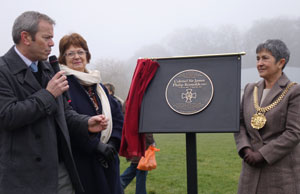
Woolton Woods 8 February 2015 - 150th anniversary of the birth of Sir
James Reynolds
who in 1917 "gifted these two open fields to the people of Liverpool".
Land Trust Study demonstrates value of green spaces to society
This recent study found that every pound invested in parks
and nature reserves contributes £30 towards health and well being
benefits and £23 towards crime reduction and community safety.
The national land management charity, the Land Trust, commissioned an
independent study by economic consultants, Carney Green to assess
the value of the green spaces in its portfolio. The study measured the
impact of Land Trust services to identify the value that people place
on their local green space as well as to estimate the financial value
it contributes to the health and social sectors.
Follow these links for more details:
The
Land Trust Study demonstrates value of green spaces to society
The Carney Green research for The Land Trust 'Perceptions
Survey and Social Value Study' pdf
Cuts to Local Authorities impact on Greenspace
The Government’s cuts to Local Authorities for local
public services, combined with the lack of statutory protection for open
spaces, are causing real threats to urban greenspace. This is provoking
a growing number of local grass-roots campaigns throughout Britain as
local communities mobilise to defend spaces under threat of neglect, privatisation
or sell-offs.
At the same time the evidence continues to stack up on the vital and unique
role our parks and greenspaces play for health, biodiversity, flood control,
climate change mitigation, social cohesion and many other essential needs
of all sections of all our communities.
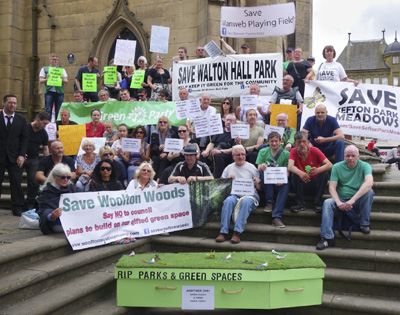
4 July 2015 - one of the demonstrations organised by Save
Our Green Spaces - Liverpool
Add news and information to this site
Our Ground welcomes any information about your campaign and the loss of
public open greenspace on Merseyside. Please send your information to
info@ourground.net
updated 25 November 2016 © Our
Ground 2007 - 2016